
🦭 Climate Education for the Agency of our Lifetimes
A special guest post by #NextGenEdu in advance of a workshop we're co-hosting in Bangkok next Thursday (October 2)
💡This is a special guest post by our collaborators at #NextGenEdu and Ridiculous Futures, whom Seapunk Studios is honored to be co-hosting a one-day workshop with this coming October 2, as part of our program (on Rewilding Seasian Climate Agency; more in tomorrow’s post) at Bangkok Climate Action Week 2025. If you — or folks you might know — are interested in the intersections of climate agency, pedagogical reimagination, and the global south, consider yourself invited. 🪸
What does climate agency look like…
For someone who has never had electricity at home?
For someone whose land and memories are already under water?
For someone whose entire culture may soon be erased by rising seas?
For someone whose lifestyle was already ‘sustainable’ by carbon standards, but whose poverty is locked in by global economic arrangements they did not choose?
We live in the hottest years ever recorded, and the coldest of the rest of our lives. Climate change is not a distant horizon — it is the defining condition of our lifetimes. And yet much of what passes for climate action, and climate education, feels strangely hollow.
Students are told to recycle bottles, plant saplings, and turn off the lights. Cafés boast about banning plastic straws. Governments promote electric cars and carbon offsets as if these gestures could hold back the seas. These efforts are not meaningless — but they are performative. They soothe anxieties while leaving deeper structures of power and responsibility untouched.
What’s missing is not more information — but curiosity, connection, and collective agency. Education too often teaches about climate change, but not how to live through it, act on it, or imagine alternatives together. Without grounding in local realities, experiential learning, and justice, climate education risks becoming a form of denial.
That is why we are proposing CEAL — Climate Education for the Agency of our Lifetimes.
CEAL is not a fixed framework. It is a shared search: for what climate education is today, what it needs to become, and how we might shape it together. Not just to endure crisis in isolation — but to build solidarity, imagination, and agency in the face of it.
💡 CEAL Workshop — October 2, Bangkok Climate Action Week
#NextGenEdu, Seapunk Studios, and Ridiculous Futures will be hosting a one-day workshop to unpack, reimagine, and design for CEAL in Bangkok on Oct 2, 2025, as part of Bangkok Climate Action Week.
The Gap: From Scattered Lessons to Collective Agency
Climate is already present in many forms of education. In Bangladesh, for instance, a review of the national curriculum shows references scattered across subjects: Bangla, Science, English, and Religion in primary school; Agriculture, Biology, Chemistry, and Social Studies in secondary. Learners encounter lessons on planting trees, seasonal changes, pollution, even disasters like cyclones.
These lessons rarely connect into a larger whole. They are offered as facts to memorize or tasks to complete: a rhyme about nature, a drawing exercise, a description of greenhouse gases in a chapter. What is missing is a thread that links across subjects, across years of schooling, and into the lived realities of people already facing loss and damage in their communities.
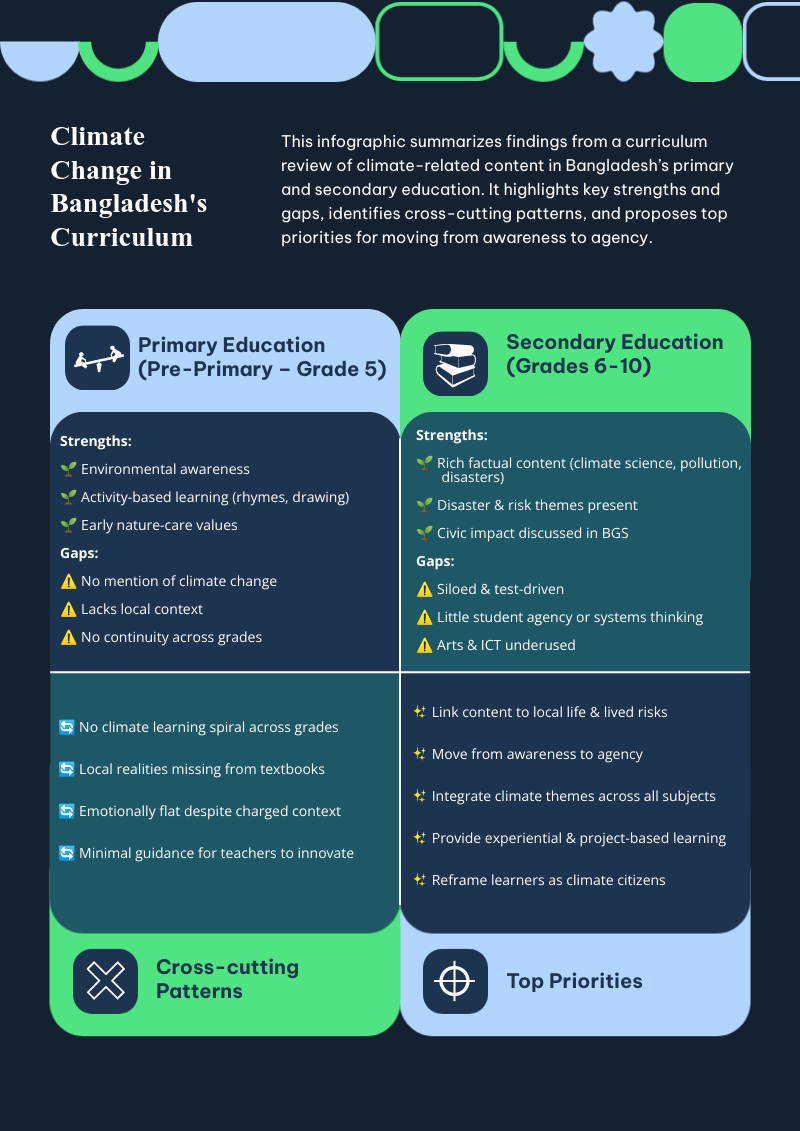
One striking example comes from a Grade 5 English book that includes a passage on Cyclone Aila, a devastating storm that displaced millions. The lesson stands alone, disconnected from science, civics, or collective action. Learners discover that it happened, but not what it means for their futures, or what responses might be possible together.
This pattern extends far beyond Bangladesh. Across Southeast Asia and elsewhere, climate education is often fragmented, emotionally flat, and disconnected from justice. People learn about crisis, but not how to live through it with dignity or act meaningfully within it.
Yet there is possibility. Human beings are naturally curious; we look for meaning and ask what comes next. When education, whether in schools, workplaces, communities, or cultural spaces, connects to local risks, shared knowledge, and lived experience, it moves beyond awareness and into agency. This is the promise, and the challenge, that CEAL seeks to take on.
The Climate of Our Lifetimes
Climate change is no longer a horizon to prepare for; it is the condition we already inhabit. Rising seas, disappearing glaciers, heat waves, floods, and mass extinctions are not predictions of tomorrow but markers of today.
This reality unsettles the way we think about education. For too long, education has been framed as preparing the next generation. CEAL begins from a different truth: everyone alive today is already inside the crisis. Education is not only for children in classrooms but for all of us — parents, workers, farmers, artists, activists, leaders, and elders.
What does it mean to learn in a world where the ground is shifting beneath us, sometimes literally? What mythologies, metaphors, and shared narratives help us make sense of this moment? Writers like Amitav Ghosh and Andri Snær Magnason (On Time and Water) remind us that our stories must expand to match the scale of the crisis. Facts and figures are not enough. We need ways of teaching and learning that connect grief with imagination, memory with responsibility, and urgency with agency.
CEAL names this shift. It treats climate education not as a niche subject, but as the ongoing process by which societies learn how to endure, adapt, and act together in the face of the defining challenge of our lifetimes.
No Meaningful Climate Action Without Meaningful Climate Agency
Everywhere we turn, there are campaigns urging climate action. In one city, recycling drives. In another, bans on plastic straws. Elsewhere, electric vehicles, offset schemes, cap-and-trade, climate marches, even lifestyle pledges to fly less. These acts signal commitment, yet they rarely shift the deeper structures of power or responsibility.
Whose action counts, and whose agency matters?
What does climate agency look like…
For someone who has never had electricity at home?
For someone whose land and memories are already under water?
For someone whose entire culture may soon be erased by rising seas?
For someone whose lifestyle was already ‘sustainable’ by carbon standards, but whose poverty is locked in by global economic arrangements they did not choose?
Performative actions without meaningful agency risk becoming rituals of denial. They allow us to imagine we are doing something while sidestepping the harder work of justice. Agency, by contrast, is the ability to act with awareness of power, inequity, and responsibility. It is the capacity to imagine alternatives and to work collectively toward them.
CEAL begins here: with the insistence that education must not only inform people about crisis but also nurture the agency needed to face it. Without that, climate action is empty.
CEAL as Concept
CEAL is not a finished framework.
It is an idea we are putting forward because the gap is too urgent to ignore.
CEAL names both a challenge and an invitation: to reimagine climate education as the process by which societies nurture the agency needed to face crisis together.
CEAL rests on a few simple but powerful values:
Justice literacy: understanding who causes, who suffers, who decides, and who pays.
Preparedness: building tools and practices to anticipate, adapt, and respond.
Solidarity: creating bonds across communities and generations rather than replicating patterns of exploitation.
Imagination: cultivating futures thinking, science fiction, and social fiction to expand what feels possible.
Education in this sense is not confined to classrooms or curricula. It happens in schools and universities, but also in communities, workplaces, households, and cultural spaces. It includes art, protest, storytelling, and memory. It is not only about surviving crisis, but about shaping how we live, act, and imagine within it.
CEAL does not prescribe a single pathway. Instead, it invites educators, creators, and communities to experiment, prototype, and share what climate education for agency could look like in practice. It is a collective search, still in motion.
Invitation: From Performative to Transformative
CEAL is not just a concept on paper. It is a living experiment.
On Thursday, October 2, 2025, during Bangkok Climate Action Week, we will gather educators, creators, and practitioners to test, prototype, and debate what climate education for agency might look like.
The workshop will be a laboratory for designing new practices — from classroom activities to community prototypes, from storytelling tools to policy experiments.
CEAL is not ours alone to define. It emerges from a journey already in motion — decades of climate struggles, educational experiments, and justice movements. What we offer is a way to name and navigate this search together. CEAL will continue to take shape through dialogue and practice across regions and generations.
The invitation is simple: help us explore what climate education could be when it is rooted in justice, solidarity, and imagination. Share your stories. Bring your practices. Join the search for ways of learning that do not only describe the crisis, but build the agency to face it.
We cannot always choose the worlds we are born into. Yet together, we can choose how to live, learn, imagine, and act meaningfully within them.
💡 CEAL Workshop — October 2, Bangkok Climate Action Week
#NextGenEdu, Seapunk Studios, and Ridiculous Futures will be hosting a one-day workshop to unpack, reimagine, and design for CEAL in Bangkok on Oct 2, 2025, as part of Bangkok Climate Action Week.